Staff Engineer vs. Senior Engineer: The 5 Mindset Shifts That Actually Matter
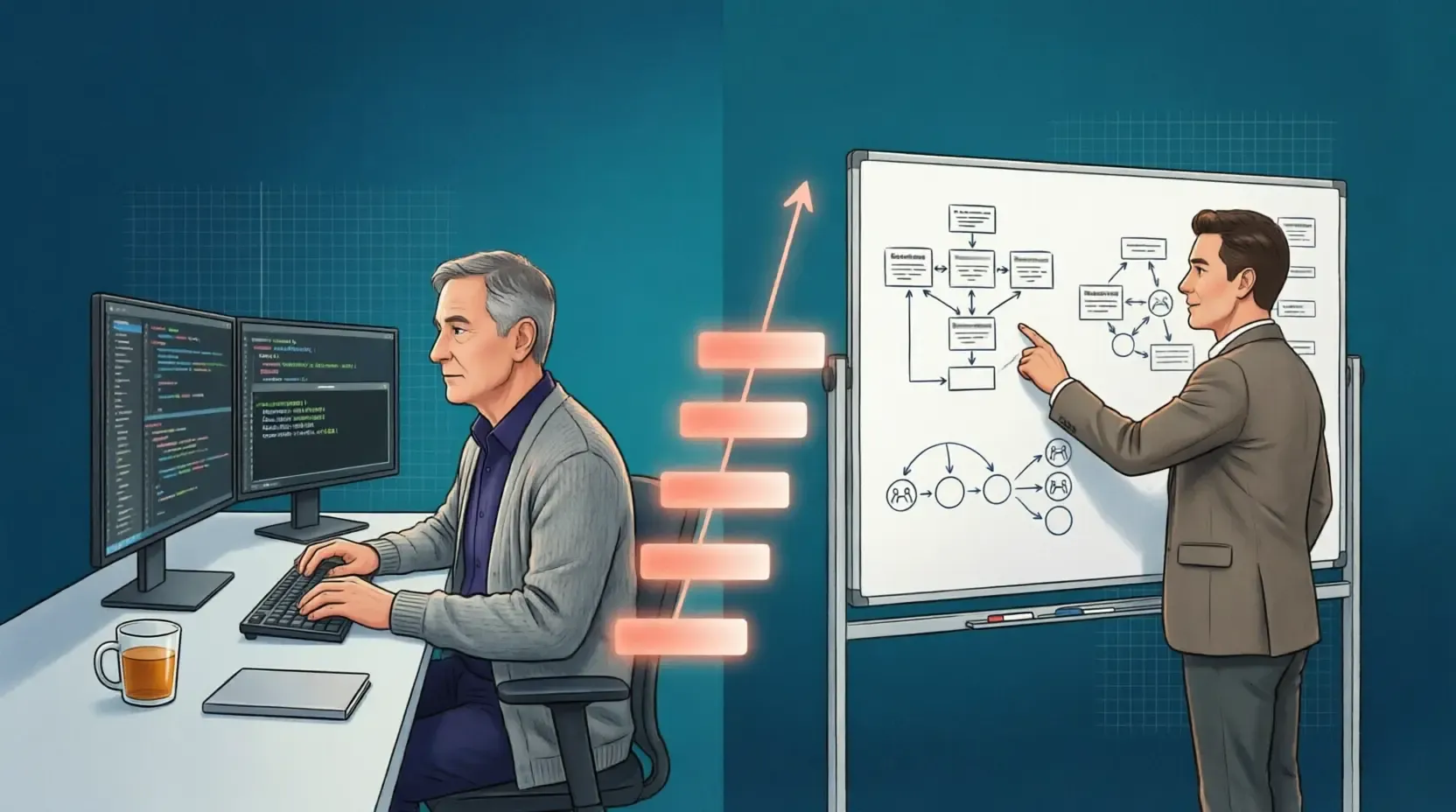
If you've searched for "staff engineer vs senior engineer," you've probably found a dozen articles listing skills, scope, and org charts. Those things matter, but they don't explain why so many strong senior engineers stall out before reaching staff level.
The real gap isn't a skills gap. It's a mindset gap.
This article breaks down the five mental shifts that separate senior engineers from staff engineers — the internal changes in how you think about your work, your time, and your impact, not just the external changes in title or scope.
Quick Summary: Senior vs. Staff Engineer at a Glance
DimensionSenior EngineerStaff Engineer
Primary unit of work
Tasks and projects
Problems and systems
Scope of influence
Team
Multiple teams / org
Default question
"How do I build this well?"
"Should we build this, and what happens if we do?"
Relationship to ambiguity
Resolves it when assigned
Seeks it out proactively
Source of leverage
Personal output
Multiplying others' output
Now let's look at what actually drives that table — the mindset shifts underneath it.
1. From "Solving Problems" to "Choosing Problems"
Senior engineers are excellent problem solvers. Give them a well-defined ticket, a bug, or a feature spec, and they'll execute it efficiently and correctly. This is genuinely valuable — and it's also the ceiling.
Staff engineers spend a disproportionate amount of their time deciding which problems are worth solving at all. That means:
- Questioning whether a requested feature addresses the actual root cause
- Noticing that three teams are independently solving the same problem badly
- Killing projects that look busy but won't move the needle
The mindset shift: Stop asking "how do I solve this well?" and start asking "is this the right thing to be solving?" Senior engineers optimize execution. Staff engineers optimize the target you're executing toward.
2. From Owning Code to Owning Outcomes
A senior engineer's identity is often tied to code quality, architecture decisions within their domain, and being the go-to expert on a specific system. That's a strong, defensible identity — but it's also a narrow one.
Staff engineers detach their sense of ownership from any single codebase. Their job is the outcome, not the artifact. That might mean:
- Advocating for a solution they personally won't build
- Deprecating a system they designed because a better path emerged
- Spending a week in meetings instead of an IDE because that's where the leverage is
The mindset shift: Your value isn't measured by lines of code or systems you personally maintain. It's measured by whether the right outcome happened — even if someone else's fingerprints are all over it.
3. From Reactive Ambiguity to Proactive Ambiguity
Senior engineers are comfortable handling ambiguity when it's handed to them: an underspecified ticket, a vague bug report, a "figure it out" request from a PM. They resolve it and move forward.
Staff engineers go looking for ambiguity before anyone flags it. They're the ones asking:
- "What happens when this system hits 10x the current load?"
- "Nobody owns this failure mode — should someone?"
- "We keep having the same argument in every design review. What's the actual unresolved question underneath it?"
The mindset shift: Don't wait for uncertainty to be assigned to you. Actively scan for the risks, gaps, and unasked questions that no one else has noticed yet — because staff-level problems are rarely handed to you gift-wrapped.
4. From Personal Leverage to Multiplied Leverage
A senior engineer's leverage is roughly linear: work harder or smarter, and output goes up proportionally. This is a real ceiling, and it's one that raw effort can't break through.
Staff engineers create leverage that scales beyond their own hours in the day:
- Writing a design doc that saves five teams from repeating the same mistake
- Building an internal tool that removes a recurring bottleneck for the whole org
- Mentoring engineers in a way that changes how they make decisions, not just what they build today
The mindset shift: Ask "what will make everyone around me more effective?" instead of "what can I personally ship this week?" Multiplied leverage compounds; individual output doesn't.
5. From Being Right to Building Alignment
Senior engineers are often rewarded for having the correct technical answer. Being right, quickly, is a genuine skill — and in senior-level scope, it's usually enough.
At staff level, being right isn't sufficient if nobody agrees with you. Staff engineers have to:
- Build consensus across teams with competing priorities and incentives
- Communicate technical trade-offs to non-technical stakeholders in terms they can act on
- Accept a "good enough and agreed upon" solution over a "perfect but contested" one, when the org context calls for it
The mindset shift: Correctness is necessary but not sufficient. Influence, communication, and organizational trust become as important as technical judgment — because at scale, unadopted good ideas have zero impact.
How to Know If You're Already Making These Shifts
You don't need a title change to start practicing staff-level thinking. Signs you're already moving in this direction:
- You've talked a team out of building something, and they thanked you for it later
- People from other teams seek you out before a project starts, not after it breaks
- You've written something (a doc, a framework, a set of guidelines) that outlived the project it was written for
- You spend meaningful time on things that don't show up in your own sprint
If none of these feel familiar yet, that's not a failure — it's just a signal of where to focus next.
Final Thoughts
The senior-to-staff transition isn't really about scope, title, or even technical skill — those are downstream effects. It's about a set of internal shifts in how you choose problems, define ownership, seek out ambiguity, create leverage, and build alignment.
Skills got you to senior. Mindset is what gets you to staff.